
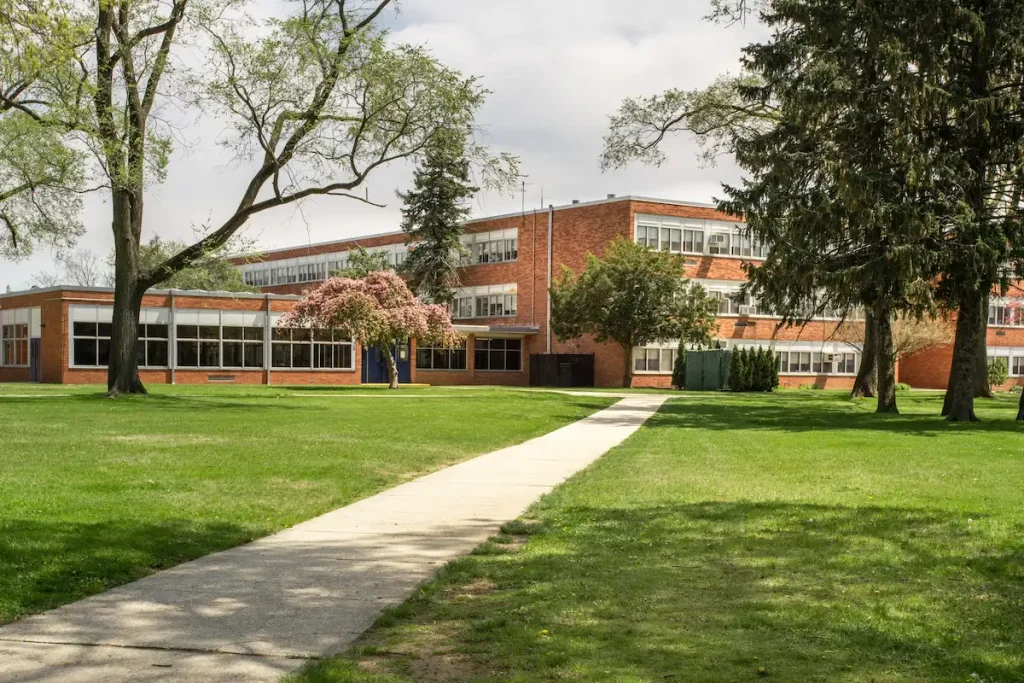
When Marcus took over facilities management for a Tennessee school district eleven years ago, radon testing was not on the maintenance calendar. He had walked those buildings hundreds of times. He checked HVAC filters, tracked roof repairs, and logged every work order. The buildings looked sound. There was no odor and no visible sign of an air quality problem.
Then the district ran its first formal radon survey. Two ground-floor classrooms came back above the EPA action level of 4.0 pCi/L. Marcus said later that the results changed how he saw buildings he knew so well. Radon moves through soil and enters through foundation cracks, utility penetrations, and floor joints. You cannot see it or smell it, which is exactly why organized testing programs exist. Children spend six to eight hours a day in these buildings, and that steady occupancy makes school radon testing a clear public health priority.
The EPA recommends that every school test for radon and offers school-specific guidance. Even so, estimates suggest only about 20 percent of U.S. schools have tested at all. That gap matters. Radon is the second leading cause of lung cancer in the United States, and the leading cause among non-smokers, according to EPA data. The same health risks that make radon a concern in homes apply in classrooms, gyms, and daycare centers where children spend hours at or below ground level.
Many families ask reasonable questions about radon exposure for younger occupants, especially in daycare or elementary rooms at slab level. Public health authorities agree on the basics. Reduce exposure for everyone, and test regularly, because radon causes no immediate symptoms. The risk builds over time, so early and regular testing is a simple protective step.
Key Takeaways
Why schools are a priority: Children spend 6-8 hours a day in these buildings, and steady ground-level occupancy raises cumulative exposure over years.
The EPA recommendation is clear: The agency urges every school to test and offers guidance, yet only about 20% of U.S. schools have done any testing.
No symptoms signal exposure: Radon produces no immediate symptoms, so testing is the only way to know a building’s levels.
Daycares carry similar risk: Daycare rooms often sit at ground or basement level, creating the same exposure concern as undertested schools.
The action level is 4.0 pCi/L: The EPA urges action at 4.0 pCi/L and suggests weighing action between 2.0 and 4.0, since no level is fully safe.
Mitigation works: Per EPA guidance, sub-slab depressurization can cut indoor radon sharply, with reductions of up to 99% in some cases.
Certified testing matters: Schools and daycares need testing that follows ANSI/AARST commercial standards, which differ from residential protocols.
To schedule professional school or daycare radon testing, call Radon 1 at (615) 257-9818.
Why Do Schools Have Radon Problems?
Radon flows from soil into occupied spaces through cracks, floor joints, sump openings, and porous materials. Pressure differences pull it inside. Schools face the same risk that affects basements and ground-floor offices: direct soil contact, foundation penetrations for utilities, and lower indoor pressure than the soil below. Classrooms at slab level or below grade touch more radon-producing soil than upper floors. A ground-floor science room in a 1970s building may show measurable radon while the second-floor library shows none.
Building age adds to the picture. Older construction has more cracks, worn sealants, and open penetrations, so soil gas finds more ways in. That does not make new schools automatically safe. Levels depend on local geology, soil, and pressure, all of which vary by site. The EPA’s radon zone maps show general regional risk, but the agency is clear that high levels can appear in any zone. Only a test on the specific building reveals its true level.
How Is Radon Testing Done in a School or Daycare?
School radon testing follows commercial measurement protocols under ANSI/AARST standards, which differ from residential testing. These standards fit multi-room, multi-floor buildings. They set where to measure, how long to run tests, and how to read results.
In most programs, a certified professional places continuous monitors or passive detectors in every regularly occupied room at or below grade. That usually means ground-floor classrooms, gyms, cafeterias, offices, and any below-grade storage that staff or students use. A home test covers the lowest livable level. A school survey may need dozens of individual room tests for a full picture.
Duration and closed-building conditions matter. Many commercial tests run long enough to account for HVAC cycling and occupancy, which shift air pressure and ventilation. A certified technician sets the right protocol for the building and documents results room by room. That record becomes the baseline for prioritizing any mitigation. The gap between a certified commercial professional and an uncertified tester is real here. NRPP and AARST standards exist to keep testing defensible. Our overview of what certified radon technicians are trained to do helps administrators judge credentials.
What Happens When a School Tests Above 4.0 pCi/L?
When results exceed the action level, the answer is a professionally designed mitigation system. Schools most often use sub-slab depressurization, the same core method used in homes but scaled for larger floors and complex HVAC. A crew creates a suction point beneath the slab. A PVC pipe carries radon-laden air upward. An inline fan vents it above the roofline before it can re-enter through windows or intakes.
Many schools also have crawl spaces, slab-on-grade sections, and older construction that need extra design work. A competent commercial contractor assesses the foundation, HVAC, and layout before specifying a system. EPA guidance says mitigation can cut indoor radon by up to 99 percent in some cases, though the actual result depends on the building. Post-mitigation testing then verifies performance. It helps to know what a complete commercial mitigation system includes before signing off on a scope.
The timeline is usually manageable. Installation in a school often takes one to several days, depending on the number of suction points. How long radon mitigation takes varies with building complexity, but most systems run before the next occupancy window. Scheduling the work over a weekend, holiday break, or summer keeps active buildings clear.
Are There Testing Requirements or State Programs?
At the federal level, the EPA recommends school testing but does not mandate it through one national law. Requirements vary by state. Some states run voluntary programs with guidance and sometimes subsidized test kits for districts. Tennessee administrators should contact the Tennessee Department of Environment and Conservation for current guidance. The EPA’s state radon contact list gives program details for each state Radon 1 serves, including Kentucky, Alabama, Georgia, and North Carolina.
For daycares, the rules are just as uneven, but the exposure concern is identical. Young children who spend full days in ground-level or basement rooms carry the same cumulative risk as students in a classroom. Many childcare licensing bodies recommend testing even when they do not require it. Administrators who want a documented baseline, or who are answering parent questions, are better served by a certified professional test than by DIY methods. For large facilities with many rooms and zones, commercial radon mitigation professionals who understand multi-unit protocols are the right resource.
Frequently Asked Questions
How is radon testing in a school different from testing a home?
School radon testing follows ANSI/AARST commercial measurement standards rather than residential protocols. Testing covers every room at or below grade that is regularly occupied, which can mean dozens of individual test placements in a single building. Results are documented room by room, and a certified professional interprets them against commercial guidance rather than residential benchmarks.
Can a school use DIY radon test kits to check its classrooms?
Hardware store radon kits are designed for single-room residential use and are not calibrated or documented to meet commercial measurement standards. For a school or daycare, a certified professional using equipment appropriate for commercial building surveys is the recommended approach. This produces results that are defensible, properly documented, and actionable.
How often should schools retest for radon?
The EPA recommends retesting after mitigation to confirm system performance and suggests retesting every two years to ensure levels remain low. Schools that have never been tested should establish a baseline before setting a retest schedule. Any major renovation to HVAC systems, flooring, or foundation areas is also a trigger for retesting because these changes affect how radon moves through the building.
What radon level requires action in a school building?
The EPA action level of 4.0 pCi/L applies to schools as it does to homes. The EPA also encourages considering corrective action for levels between 2.0 and 4.0 pCi/L because there is no completely safe exposure threshold. In a school context where occupants spend many hours on-site daily, erring toward action at the lower end of that range is a reasonable precautionary position.
Who should schools hire to perform radon testing and mitigation?
Schools should hire a contractor certified through NRPP or AARST with documented experience in commercial building testing and mitigation. Certification credentials can be verified through the National Radon Proficiency Program. For mitigation work specifically, the contractor should provide a written scope, a post-installation verification test, and documentation of results. Asking about experience with occupied buildings and scheduling flexibility around school hours is also a practical part of contractor selection.
Radon 1 provides professional school and commercial radon testing and mitigation across Tennessee, Kentucky, Alabama, Georgia, and North Carolina. With over 20,000 systems installed and more than 20 years in business, our NRPP-certified teams in Nashville, Knoxville, and Chattanooga are equipped to handle multi-room educational facilities from initial testing through post-mitigation verification. We also offer a price match guarantee, which can matter when school districts are working within fixed budgets. If your school district or daycare facility has not been tested, or if you have results that require a mitigation plan, call Radon 1 at (615) 257-9818 to schedule a site assessment.